
One of the common complaints from my clients is that they feel they just cannot get their people to engage or take ownership of what they do. Sometimes this is then followed by a comment such as ‘Well, the young people today just don’t care.’
The issue is that it is the leader’s responsibility to create a culture of ownership. It’s not that young people don’t care; rather, it’s that you haven’t been able to create an environment that engages them and leads to them taking ownership. In this article, I will provide you with key areas to consider when creating a culture of ownership in your dental practice.
The CADA Model of Ownership
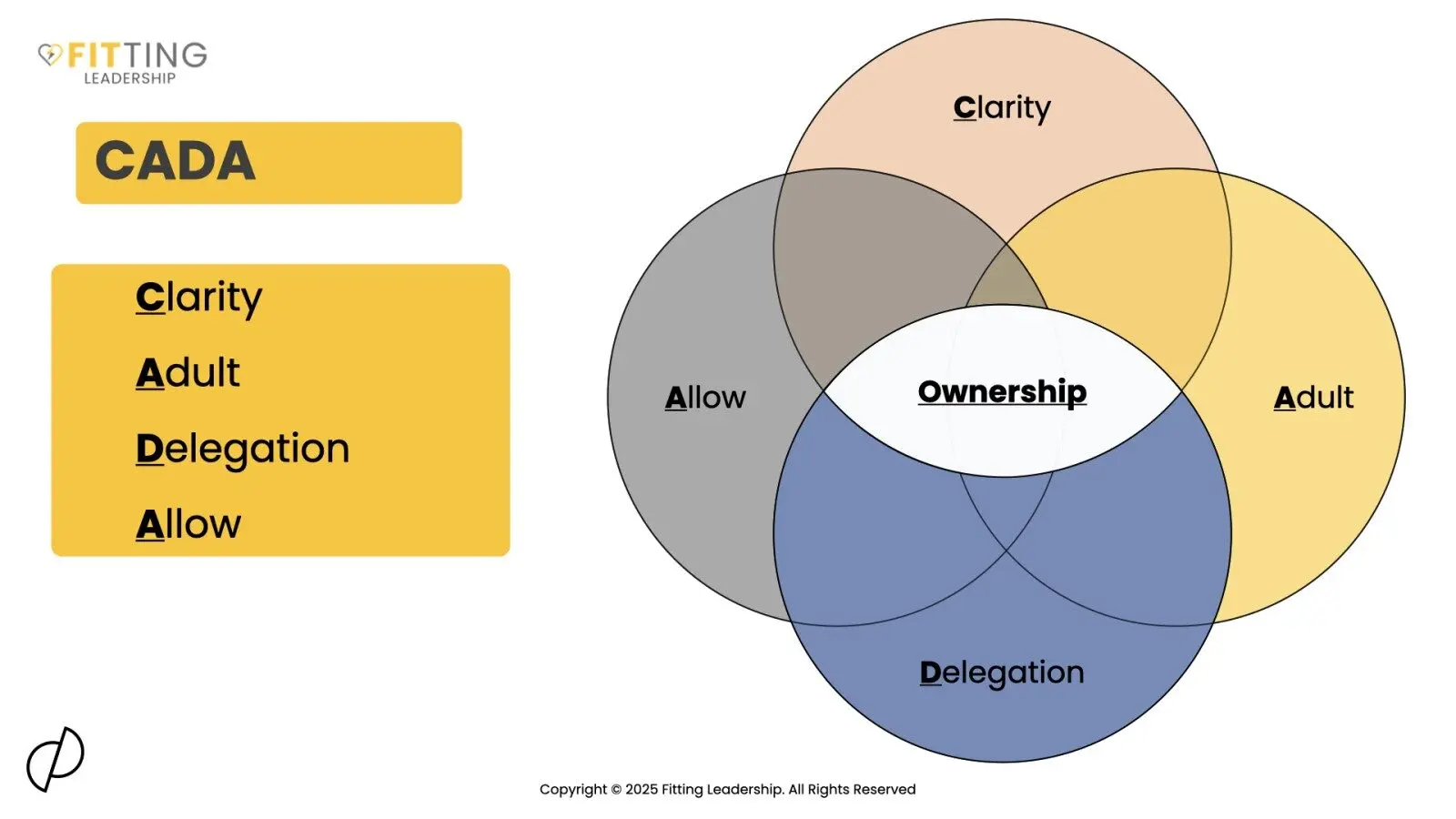
I am introducing you to an acronym called CADA.
- Clarity
- Adult
- Delegation
- Allow
You have to provide clarity of what the practice is about, where it is heading, what it’s there to do, and clarity of overall responsibility for individuals.
You have to treat your employees as adults and not has children. They are not children. They are fully grown adults, and you want to create an adult-to-adult environment.
It’s not just about delegating. It’s about delegating effectively, according to the situation. Delegation is not one size fits all, and it certainly isn’t just do this.
Finally, you have to allow, and this is more of a mindset in that you have to allow people to take ownership. You have to allow people to perhaps even make mistakes. You have to allow people to succeed. If you do this people will continue to grow and thrive, but if you don’t allow this they won’t and they won’t take ownership.
Clarity

Clarity of vision
If you want people to take ownership, you must help them understand and provide clarity about where your practice is heading. What is the vision for the future? Where are you trying to get to? If you don’t give them this, then even if you get them to take ownership, they may take ownership in doing the wrong thing, which is not going to take your practice in the direction you want to go. More likely, it will lead to people not actually taking action because they have no clarity around what direction to take; they will tend to freeze and not take any ownership or action without you telling them exactly what to do.
Clarity of values
Values give people an understanding of what is okay and what is not okay. It also helps people understand what the practice stands for and gives people a compass to help them in making decisions and in how they behave on an ongoing basis. Give people a voice in developing those values, and then continually referring back to them helps people understand that they are real, and this gives them a level of confidence in doing the right thing and taking ownership without having to wait for guidance or instruction.
Clarity of purpose
If people understand the purpose of the practice, they understand the contribution that it makes to the community in which it operates. They understand that it is more than just a business making money, but that it really contributes and has an impact on the community in which it operate. They too can also then contribute and make an impact. Helping them understand their role within that gives them a level of energy and purpose to what they do and makes them feel that what they do has real value. It encourages them to really take ownership and to continually strive to provide that purpose to the people that your practice serves.
Clarity of responsibility
When I look at job descriptions, what I often see is a list of tasks that people are meant to do. When I look at these tasks, they are very specific and it doesn’t typically give the person an indication of overall what their responsibility is.
If an individual doesn’t know what their overall responsibility is, then you cannot expect them to take broader ownership because they are not sure what their broader responsibility is.
It is therefore critical that we give real clarity around what their overall responsibility is.
An example of this would be that we give a treatment coordinator a list of different tasks that they are responsible for doing such as following up. Leads could be one. We also need to provide their overall responsibility such as they are overall responsible for bringing new patients into the practice and give them a measure of success for this responsibility. This will enable them to then be proactive and take ownership in driving up the levels of new patients coming into the practice because they actually know what their overall responsibility is. They won’t be continually waiting around to be told what to do because they know what they could do to contribute to their area of responsibility. They also know how this fits into the broader picture of where the practice is heading.
Creating an adult environment and treating people like adults

When we are kids, our brains are not fully developed, and so we are not capable of making decisions and doing things on our own accord. When people are employed and working for you, they are fully grown adults and yet I often witness leaders treating them as if they are kids. What do we do with kids? We tell them off. We specifically tell them exactly what to do. We keep a very close eye on them so that they don’t come to harm to name a few. Sometimes I see leaders doing the same thing with their employees and the people they lead. They tell them off, keep a close eye on them, and don’t allow them to do what they think is right. They also don’t allow them to make their own decisions. They become very reliant on you and will always look to you to help them and make decisions as a child would. They don’t take ownership.
Your interactions
You can change this by setting an example in terms of your interaction with your people.
You can be the adult, meaning that if somebody comes to you, you can be respectful, you can listen to them and engage with them on an adult-to-adult basis, as though you are equal, you engage with them, not as their superior, but on an adult-to-adult, being-human basis. What does this look like? It means giving them time, it means listening, it means being present with people, it means valuing their time as much as your time and valuing their opinion and perspective. Simply put connecting with them on an equal level. It also means practically, not always telling them exactly what to do. Not always doing it for them. It means helping them to learn, rather than telling them off. It means giving them confidence to make their own decisions and to do it their way.
Team Interactions
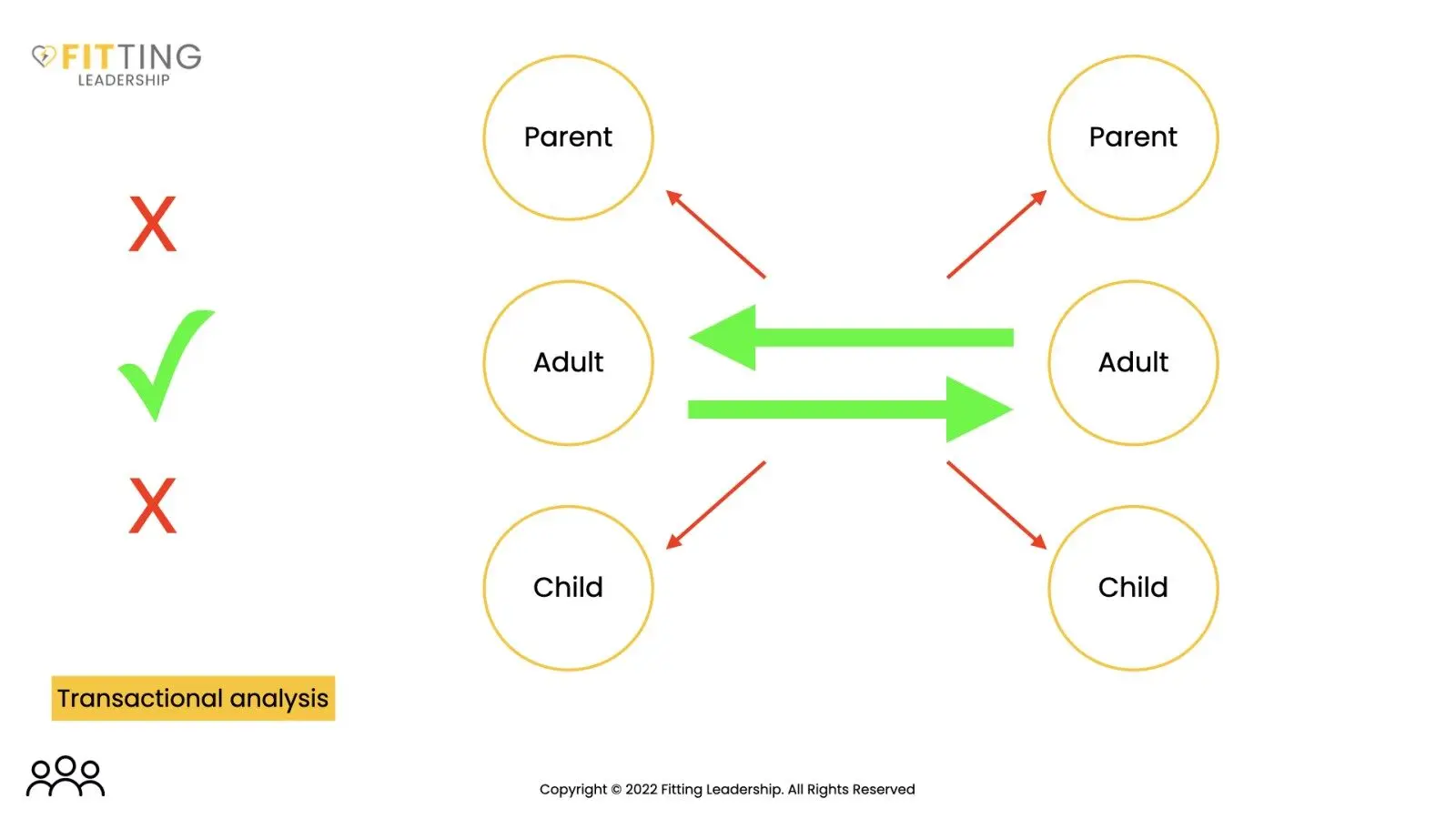
There is a model related to this concept, which is called transactional analysis. This states that there are three ego states in which we operate as adults. We are acting either as a parent, an adult, or a child. The classic example I give of this type of behaviour in a dental practice is when a nurse comes to you or the practice manager, complaining about another nurse or colleague. In this situation, they are behaving like a child. They are complaining about their sibling. They are coming to you as the parent to sort it out. This is where it becomes really important in how you respond to this. If you respond as the parent and go to speak to their colleague, then they will continue to behave like a child, and the rest of the team will follow suit. You will continue to have lots of parent and childlike behaviour. If, on the other hand, you behave like an adult and suggest to them that they talk directly to that person about their concerns or what they are unhappy about, you are interrupting that parent-to-child-like behaviour and creating an adult-to-adult environment.
The point being that we start to then create overall a really adult environment where people don’t look to others, but they recognise they are an adult and they have the capability to take ownership and responsibility within the practice.
Delegate Effectively

Actually Delegate
If you don’t delegate, you cannot give ownership. The first thing you have to do is actually to delegate. When you delegate, you give people ownership and responsibility. You provide them with a level of confidence and self belief because you are in essence telling them that you have confidence and faith in their capability to do things. If you don’t delegate tasks to people, you are in essence, giving them a vote of no confidence. Even if you are not intentionally doing this, it is likely how they will receive it or unconsciously feel about it. The first thing is to actually delegate.
Delegate appropriately
When you delegate it is not one size fits all. You must delegate differently according to the situation and the individual. As an example, how you delegate to somebody who is relatively new and inexperienced in a position versus how you delegate to somebody who is very experienced and very capable will be very different. Sometimes, people leaders either delegate fully to these very experienced people and then don’t delegate at all to these inexperienced people, but that is often where the frustration lies. We must delegate appropriately and develop individuals so that they gradually assume more ownership.
Your way isn’t the best way
Your way may not be the best way. Yeah, crazy right. The reality is that as things move, quicker and quicker and quicker you are not necessarily going to know everything about all the different roles and responsibilities in the practice and you are not necessarily going to be the best person to decide how to do it the best way. The person who is closest to the job i.e. actually doing the job is the person who is likely to know the best way to do it. If we give people responsibility and ownership and ask them how they would do it, we would likely have the best outcome. It also means that they start to think for themselves rather than waiting for you to tell them how to do it. Ultimately, it will mean that they will start to take ownership.
Ask questions, don’t tell
The typical way people delegate is to tell someone what to do. This may be appropriate in certain situations, but it doesn’t transfer responsibility and ownership to the other person. It really still remains yours rather than transferring the ownership to the other person. If, on the other hand, you give them a broad area or an end point of what you are looking for, and then ask them how they see it and how they would do it. It becomes theirs and not yours. You are transferring ownership over to them.
Don’t do it for them
Don’t do it or them! This is something you may do and feel the urge to do. It comes back to that parental behaviour, which is we do it for them rather than encouraging them to do it themselves. This means they will not take ownership if you do this because they’ll be waiting for you to do it. Please don’t do it for them. This also comes back to ask questions don’t tell because people say to me well when I ask people they say I don’t know or that they’re expecting you to tell them. Well they probably are because you have in the past. You have to change that. Instead you could say well I’ve got some ideas, but I actually wanna hear from you as to how you want to do it.
Allow others to take ownership and let go!

This is about a mindset in terms of how you approach everything that I have discussed above. You have to be prepared to allow people to make decisions and to do it their way. This means you will have to let go and relinquish control appropriately. Take some time to reflect on your own personality and where your natural style sits. Some of us have stronger control tendencies than others. Be aware of this and know when it’s time to move out of your comfort zone and allow people to take more responsibility and for you to give up a level of control. If you do, your people will start to understand that they have genuine ownership. If you don’t, then your people will not really feel that they have ownership.
Conclusion
To conclude, all these different areas feed off and interact with each other. There is like a multiplier effect if doing all of them. If you only do one, it will likely have a small impact on creating a culture of ownership. If you do two, it will have a decent impact. If you do all three, it will have a really good impact. If you do all four you will see a massive impact. The impact increases exponentially when you do all of these because they all feed of one another. If you create clarity about the practice, treat people as humans, delegate effectively and just allow people to take ownership you will see a huge impact and create a genuine culture of ownership within your dental practice.
Take the leadership scorecard to see how effective you are as a leader.